How to Use a Winch Safely: A Step-by-Step Recovery Guide
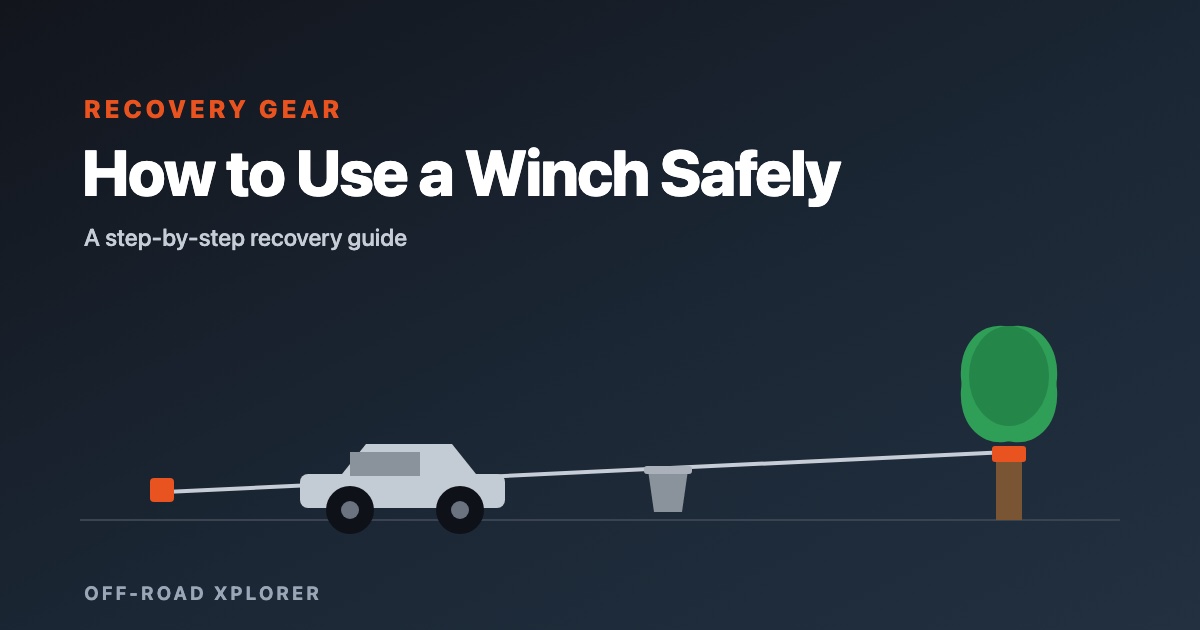
The safe sequence in one line: assess the pull, glove up, rig to a rated recovery point with a tree trunk protector, set the damper, clear everyone back to 1.5 to 2 times the line length, then pull in stages.
A winch is the most powerful tool on your Jeep, and the most dangerous one. A loaded recovery line can hold thousands of pounds of stored energy, and if a rope, hook, or anchor lets go, that energy is released in a fraction of a second. Almost every serious winching injury traces back to the same handful of mistakes: no line damper, people standing in the danger zone, rigging to the wrong point, or forcing a bad angle. This guide covers the full recovery, from sizing and rigging through the pull, the failure modes, and the after-care. It follows the procedure Warn publishes in its official Basic Guide to Winching.
If you are still choosing a winch, start with our best winch for a Jeep Wrangler guide, then come back here before your first recovery.
Gear you need before you pull
Do not rig a recovery without these. Most cost less than a tank of fuel, and every one exists to keep the line under control.
- Leather gloves. Steel cable develops sharp burrs, and synthetic rope can burn your hands. Use leather, not synthetic gloves that can melt. Warn’s first rule is simple: put on gloves before you touch the line.
- A line damper. A weighted winch blanket, or a heavy jacket or floor mat, draped over the middle of the line. If the line fails, the damper absorbs the energy and drives the broken end down into the dirt instead of letting it whip.
- A tree trunk protector. A wide strap that wraps the anchor. You never wrap the winch rope directly around a tree or rock.
- A rated D-shackle or soft shackle to connect the strap to the winch hook.
- A snatch block to gain mechanical advantage or change the direction of the pull.
- Rated recovery points on your Jeep. Rig to engineered, frame-mounted recovery points, never to a tie-down loop, a trailer ball, or a factory bumper bracket.
Is your winch big enough for the pull?
Warn’s sizing rule is GVWR × 1.5 = minimum pulling capacity. Take your vehicle’s gross vehicle weight rating, printed on the driver’s door jamb sticker, and multiply it by 1.5. Warn stresses using GVWR your vehicle’s maximum operating weight rather than curb weight, which excludes occupants and cargo, because a stuck vehicle is loaded with gear, fuel, water, and mud.
Warn’s own worked examples show how it applies across vehicle sizes: a Toyota Tacoma at 5,600 lb GVWR gives 8,400 lb minimum, and a Chevrolet Silverado 2500 at 9,900 lb GVWR gives 14,850 lb. Applying the same formula to a Jeep, a Wrangler in the 5,000 to 6,000 lb GVWR range works out to roughly 7,500 to 9,000 lb minimum, which is why most Jeeps run winches in the 8,000 to 10,000 lb class. Check the sticker on your own Jeep, since GVWR varies by generation, body style, and trim.
Round up rather than down. Warn accepts a small round-down at the light end they note an 8,000 lb winch would suffice against a calculated 8,400 lb but explicitly refuse it on the heavy Silverado, recommending a 15,000 or 16,500 lb winch rather than dropping back to 12,000 lb. The heavier the rig, the less acceptable rounding down becomes.
If your winch is undersized for a given pull, do not just hold the button down and cook the motor. Reduce the load first, then add a snatch block for mechanical advantage, and pull in short stages. A winch straining at its rated limit overheats quickly and is far more likely to fail.
Before you pull: reduce the load and pick your anchor
The safest pull is the easiest one. Before you reach for the winch, make the recovery smaller: dig the packed mud or snow away from the tires, clear rocks and debris in the path, air the tires down for flotation, and slide traction boards under the drive wheels. Every bit of load you remove is less strain on the rope, the anchor, and the motor.
Then find your anchor. The winch pulls best straight ahead toward something that will not move:
- A tree or large rock. Use a living, healthy tree, never a dead, hollow, or shallow-rooted one, because those pull over. For a light pull a trunk of at least 6 inches in diameter will do; for a full-rated pull use a tree 8 to 10 inches thick or larger, and many people treat 12 inches as a safe minimum. Wrap the tree trunk protector low at the base and join the loops with a shackle.
- Another vehicle. Park it, set the brake, put it in gear or park, and chock its wheels so it cannot be dragged toward you.
- No natural anchor. On open sand or flat ground, use a ground anchor such as a Pull-Pal, or bury your spare tire as a deadman anchor with a strap running to the surface. These are last resorts and need care, but they beat an unsafe angle to a weak point.
Get the pull angle right
A winch is built to pull straight ahead. Pulling at a sharp angle drags the rope hard against one side of the fairlead and piles it onto one end of the drum, which damages the rope, can jam the winch, and cuts your pulling power. Keep the line as straight as you can. When the anchor sits off to one side, do not force the angle. Run the line through a snatch block anchored ahead of you to redirect the pull cleanly. If the rope starts stacking to one side of the drum, stop, spool out, and re-spool it evenly across the drum before continuing.
Doubling your pulling power with a snatch block
Your winch is strongest on the bottom layer of rope on the drum. As more rope stacks onto the drum in outer layers, the effective pull drops. That is why a stuck vehicle sometimes moves once you spool more line out.
When a straight pull is not enough, run the line out to a snatch block anchored ahead of you, then back to a rated point on your own vehicle. In theory this gives a 2 to 1 mechanical advantage. In the real world, friction inside the block costs you some of that, so expect roughly 1.7 to 1.8 times your single-line pull, and remember the trade-off: your line speed is cut roughly in half. A snatch block also lets you redirect a pull around an obstacle when the anchor is off to one side.
How to run a safe single-line pull, step by step
- Assess and plan the pull. Look for a straight line between your vehicle and a solid anchor. Take your time. Most bad recoveries are decided before the motor ever turns.
- Put on your gloves. From here, one person and only one person handles the rope and operates the remote.
- Disengage the clutch to free-spool. On level ground, pull the rope out by hand to the anchor, keeping a few wraps on the drum. Never free-spool on a slope or grade with the clutch disengaged, because nothing is holding the line and the vehicle can roll.
- Rig the anchor. Wrap the tree trunk protector low and join the loops with your shackle. Attach the winch hook with the opening facing up, and always guide it with the hook strap, never your fingers on the hook itself.
- Re-engage the clutch and take up the slack slowly until the line is just tight.
- Set the damper. Drape the weighted blanket over the middle of the line. Once tension is on, nobody touches it.
- Clear the area. Every bystander stands well back and to the side, never in front of or behind the line.
- Pull in short pulls. Winch a little, stop, reassess. Let the tires help under power only if it is safe: idle the engine, in gear, with a foot ready on the brake, and never let the tires spin. Keep your hands well clear of the fairlead, especially in the last few feet of spool-in, and watch that the rope spools evenly onto the drum.
- Stop when the vehicle is free. Release tension by spooling out until the line is slack before you approach the anchor or move the damper.
- Pack up using the after-care steps further down.
The danger zone and the rules that prevent injuries
- Stand clear by 1.5 to 2 times the line length. If you have 20 feet of line out, keep everyone at least 30 feet back, and off to the side rather than in the rope’s path.
- Always use a line damper. This single accessory is the difference between a broken line dropping harmlessly and one whipping at head height.
- Never step over or straddle a line under load. Walk around it, every time.
- Keep hands clear of the fairlead on the final feet of spool-in, and use the hook strap, never the hook itself.
- Keep enough wraps on the drum. Manufacturer guidance is to leave at least 5 wraps of steel wire rope, or 10 wraps of synthetic line, on the drum. The rope anchor in the drum is not designed to hold the full load on its own.
- One operator. The person on the remote controls the pull. If a helper is signaling and the operator cannot see both of the helper’s hands, the winch does not move.
- Unplug the remote when you are not winching. A plugged-in wired or wireless remote can be triggered by accident.
- Inspect the line first. Retire steel rope with broken strands or kinks, and synthetic rope with cuts or heavy fraying. A damaged line fails at a fraction of its rating.
When the pull fails: stalls, slips, or will not move
If the winch stalls, the motor bogs down, the line slips, or the vehicle simply will not move, stop. Do not keep holding the button, which overheats the motor and the electrical parts and risks a failure under load. Release to a safe tension and reassess. Reduce the load: dig away packed material, clear the obstacle the tires are against, air down further, or put boards under the wheels. Then add a snatch block for mechanical advantage and try again in short stages. A pull that will not move at full power almost always means the load is too high, not that you should force it harder.
A winch is not a hoist
Recovery winches are rated for pulling a rolling load along the ground, nothing else. Do not use your winch to lift or suspend a load overhead, to hold a load in the air, to tow on a public road, or to move people. It has no brake or safety rated for lifting, and a failure under a suspended load is far more dangerous than a ground pull. If you need to lift, use a proper hoist or jack rated for the job.
Winch or kinetic strap: which recovery to use
Winching is a slow, steady, static pull. It is the right choice when you have a solid anchor and need control, such as a technical climb or a precise extraction near obstacles. A kinetic recovery is different: a stretchy rope or strap and a second vehicle that yanks the stuck vehicle free using momentum. Kinetic recovery is faster on open ground but stores huge energy and demands its own safety rules. If a slow, controlled pull will do the job, winch it. We cover the strap side in our recovery gear guides.
Protect the winch: motor, solenoid, and battery
Electric winch motors are built for short, intermittent pulls, not continuous running. They draw very high current and heat up quickly. Pull in stages and let the motor cool between hard pulls. If the motor smells hot or slows noticeably, stop and let it rest.
Heat is not only a motor problem. The solenoid or contactor pack that switches power to the motor also overheats under long or repeated pulls, and a stuck or heat-damaged contactor can leave the winch running after you release the button. If the winch keeps spooling on its own, or the contactor buzzes or sticks, stop and disconnect power at the battery. Treat solenoid heat as its own reason to pause, separate from motor heat.
Keep your engine running during a recovery so the battery stays charged, because a long pull can drain it fast, and a tired battery both weakens the pull and struggles to restart the engine. If you winch often, a dual-battery setup or a dedicated winch battery is worth considering.
Winching in mud and water
Grit and water are hard on a winch. If you pull through deep mud or water, expect fine debris to work into the rope and the drum. After the recovery, rinse the winch and the rope with clean water and let everything dry before storage. Water can enter an unsealed motor or solenoid, so if your winch was submerged, run it briefly afterward to help clear moisture and have it checked before you rely on it again. Synthetic rope in particular holds grit that will abrade it from the inside if you spool it away wet and dirty.
Cold-weather winching
Cold changes two things. First, rope and the drum can freeze together, and a synthetic rope spooled away wet can lock into a solid block. Free it gently and never shock-load a frozen line. Second, a cold battery has far less cranking and current capacity, so a hard pull drains it faster and can leave you unable to restart. Keep the engine running, warm the battery if you can, and expect the winch to feel weaker in deep cold.
Downhill, rearward, and rear-mounted pulls
A winch is designed to pull a load toward itself, and most winches are front-mounted for a forward pull. A downhill or rearward recovery needs extra thought. To hold or lower a vehicle down a slope, the winch controls the descent under tension, so pay the line out slowly and never let it run free. For a rearward pull, use a snatch block anchored behind you to redirect the front winch’s line, or fit a rear recovery point rated for the load. A rear-mounted winch makes rearward recoveries easier but still follows every rule here: rated points, a damper, stand clear, and a controlled pull.
Communication and hand signals
Most recoveries involve at least two people, and voice is useless over an engine. Agree on clear hand signals before you start and confirm both people understand them. At a minimum, settle on signals for spool in, spool out, slow down, and stop. A raised closed fist is a common signal for stop, and everyone should treat it as instant. The operator watches the spotter, and if the operator cannot see both of the spotter’s hands, the winch stays still. Keep bystanders out of the conversation so signals stay unambiguous.
Steel or synthetic rope: the safety difference
Both do the job, but they fail differently. Steel cable is tough and abrasion resistant, but it stores more energy and whips violently if it snaps, and it develops sharp burrs that will cut ungloved hands. Synthetic rope stores far less energy, so a failure tends to drop to the ground rather than whip, and it is light enough to handle easily. Its trade-off is that it needs abrasion protection near rock and more wraps on the drum. Whichever you run, the damper and stand-clear rules do not change.
After the recovery: rope and winch care
How you pack up decides how the winch performs next time. Spool the rope back on under light tension so it seats evenly across the drum rather than bunching, which prevents the outer wraps from burying into the inner ones on the next pull. Inspect the rope as it comes in and retire it if you find cuts, broken strands, or kinks. Dry synthetic rope before storing it. Disconnect the remote and store it clean and dry. A rope that is spooled loose, wet, or damaged is the most common reason a winch fails when you finally need it.
Frequently asked questions
What size winch do I need for my Jeep?
Multiply your Jeep’s GVWR, printed on the driver’s door jamb sticker, by 1.5 for the minimum line pull. Most Wranglers land in the 8,000 to 10,000 lb winch range on that math. Size up if you carry heavy gear or wheel in deep mud, and always work from GVWR rather than curb weight.
What do I do if there is nothing to winch to?
Use another vehicle that is parked, braked, and chocked, or set a ground anchor such as an earth anchor. On open sand you can bury your spare tire as a deadman anchor with a strap to the surface. These take more effort than a tree, but they are far safer than forcing a bad angle to a weak point.
How far back should bystanders stand during a winch pull?
The rule of thumb is 1.5 to 2 times the deployed line length, but the direction matters more than the number. The danger runs in line with the rope, both in front of the anchor and behind the vehicle, because that is the path a snapped line, hook, or shackle travels. Standing to the side is far safer than standing close but on-axis. Steel cable stores more energy than synthetic and can reach the full length of the line, so give it the larger margin.
Do I really need a winch damper, and where do I put it?
Yes, and placement matters. Set it at the midpoint of the exposed line, where a failure whips hardest, and on a pull rigged through a snatch block use two, one on each span. The weight is the point: a heavy, purpose-made damper drives a broken end into the ground, while a light cloth can be flung aside. Never walk up to adjust it while the line is under tension. If you have nothing else, a heavy bag, floor mat, or jacket beats no damper at all.
How many wraps of rope should stay on the winch drum?
Follow your manufacturer’s guidance. Warn calls for a minimum of 5 wraps of steel wire rope, or 10 wraps of synthetic line, on the drum at all times. The internal anchor is not rated to hold the full load by itself.
Can I wrap the winch rope straight around a tree?
No. Use a tree trunk protector strap around the anchor and connect it to the hook with a rated shackle. Wrapping the rope directly around a tree damages both the tree and the rope, and it can create a weak point in the line.
Related guides
- Best Winch for a Jeep Wrangler: how to size a winch and which models we recommend.
- Best Recovery Boards: the simplest recovery tool, and often the first one to reach for.
Sources are linked inline throughout, drawn from Warn Industries and established off-road safety guidance. See how we research and recommend gear.