Kinetic Rope vs Snatch Strap vs Tow Strap: Which Recovery Line?
The short answer: a tow strap is for slowly towing a vehicle that already rolls, and it has almost no stretch. A snatch strap and a kinetic rope both stretch to store energy and yank a stuck vehicle free, with a kinetic rope stretching the most. Never use a stiff tow strap to yank a stuck vehicle, and never rig any of them to a tow ball.
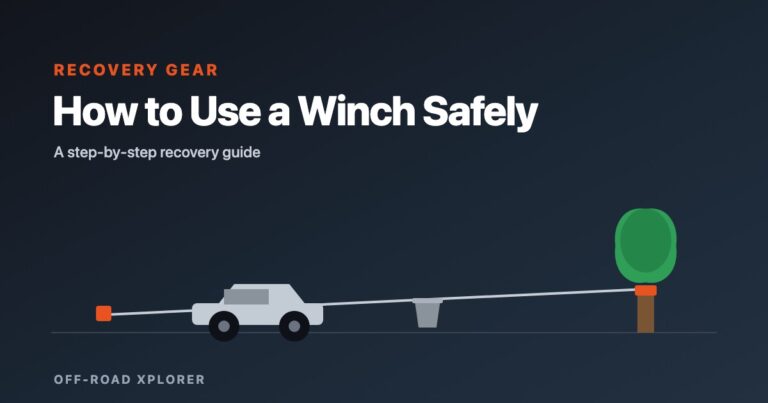
These three look similar and get used interchangeably, which is how people get hurt. Using the wrong one either fails to recover the vehicle or turns a fitting into a projectile. This guide explains what each is, how a kinetic recovery actually works, and the safety rules that apply to all of them. For the winch side of recovery, see our how to use a winch safely guide, and for the simplest tool of all, our recovery boards guide.
Tow strap vs snatch strap vs kinetic rope at a glance
| Type | Stretch | Material | Use it for | Never use it for |
|---|---|---|---|---|
| Tow strap | Low to none | Polyester | Towing a rolling vehicle slowly | Yanking a stuck vehicle |
| Snatch strap | About 20% | Nylon webbing | Kinetic recovery of a stuck vehicle | Towing or long hauls |
| Kinetic rope | Up to 30% | Nylon braid | Kinetic recovery, deeper stucks | Towing or slow static pulls |
What a tow strap is
A tow strap is a flat, low-stretch strap, usually polyester, made to pull a vehicle that already rolls freely: a dead battery, an empty tank, or a breakdown on flat ground. It often has hooks on the ends. Because it barely stretches, all it does is transmit a steady pull. That is exactly why you must not use it to yank a stuck vehicle. With no give, a sudden load slams straight through the strap and the mounting points with nothing to absorb it, which is how hooks and brackets snap off.
What a snatch strap is
A snatch strap, also called a recovery strap, is nylon webbing built to stretch around 20% under load. That stretch lets it store energy as the recovery vehicle drives against it, then release that energy to help pull the stuck vehicle free. It looks a lot like a tow strap, which is the source of most dangerous mix-ups, but the stretchy nylon and the absence of hooks (it uses reinforced loop ends) tell them apart.
What a kinetic rope is
A kinetic recovery rope does the same job as a snatch strap but is a newer, rope-style design that stretches more, up to about 30%, with higher load ratings and a longer service life. The extra stretch delivers a smoother, stronger pull, which helps on deeper stucks. It looks like a thick braided rope with reinforced eye loops at each end. Many recovery brands now consider a kinetic rope the better tool than an older snatch strap for most dynamic recoveries.
How a kinetic recovery actually works
In a kinetic recovery, the pulling vehicle gets a short run-up and drives against the rope. As the rope stretches it converts that momentum into stored energy, then contracts and releases it as a strong, elastic tug on the stuck vehicle. Because the rope stretches, the pull arrives as a firm surge rather than a hammer blow, which is easier on both vehicles than a dead-stiff yank. The stored energy is also why these recoveries are dangerous if rigged wrong: everything in the line is loaded, and any fitting that fails becomes a projectile.
The safety rules for every recovery strap
- Never rig to a tow ball. A ball hitch can snap off under a kinetic load and fly through the air. Use rated, frame-mounted recovery points only.
- Use soft shackles, not steel hooks. A soft shackle is light, strong, and if something lets go it does not become a heavy steel projectile the way a hook or steel shackle can.
- Use a damper. Drape a weighted blanket over the middle of the line, exactly as you would when winching.
- Keep everyone clear. Nobody stands in line with the strap, on either side, during the pull.
- Match the strength to the vehicle. Size the strap so its breaking strength gives a healthy safety margin over your vehicle weight, commonly a 3 to 1 factor. Undersized straps snap, oversized straps may not stretch enough to work.
How to size a recovery strap
Recovery straps are rated by minimum breaking strength, and the common guidance is a roughly 3 to 1 safety factor over your loaded vehicle weight. A strap that is too weak can fail under a hard pull, while one that is far too strong for your vehicle will not stretch enough to store useful energy, so it acts more like a stiff tow strap. Match the strap to your vehicle rather than buying the biggest one available.
Why you do not tow with a kinetic rope or snatch strap
Stretchy recovery lines need time to relax and return to their normal length after each pull. Towing keeps them under constant load with no rest, which fatigues the fibers and leads to failure. If you need to tow a rolling vehicle, use a proper low-stretch tow strap. Keep the kinetic rope for the moments you actually need a dynamic pull.
Snatch strap or kinetic rope: which to buy
If you are buying today, a kinetic rope is the more capable choice for most drivers: more stretch, higher ratings, better durability, and it resists abrasion and water better than webbing. A snatch strap still works and is often cheaper, and many people already own one. Whichever you run, pair it with two rated soft shackles and a damper, and store it clean and dry.
Frequently asked questions
Can I use a tow strap to pull out a stuck vehicle?
No. A tow strap has little or no stretch, so a hard pull shock-loads the strap and the mounting points with nothing to absorb the energy, which is how hooks and brackets break and fly. Use a snatch strap or kinetic rope for a stuck vehicle, and save the tow strap for slowly towing a vehicle that already rolls.
What is the difference between a snatch strap and a kinetic rope?
They do the same job, storing and releasing energy to free a stuck vehicle. A snatch strap is flat nylon webbing that stretches around 20%, while a kinetic rope is a braided rope that stretches up to about 30% with higher ratings and longer life. The kinetic rope is the newer, generally more capable design.
Why can’t I attach a recovery strap to a tow ball?
A tow ball is not rated for a kinetic side or shock load and can shear off, turning a chunk of steel into a projectile. Always rig to a frame-mounted, rated recovery point using a soft shackle or a rated bow shackle.
What size recovery strap do I need?
Size it by minimum breaking strength, aiming for roughly a 3 to 1 safety factor over your loaded vehicle weight. Too weak and it can snap, far too strong and it will not stretch enough to do its job.
Related guides
- How to Use a Winch Safely: when a controlled winch pull beats a dynamic yank.
- Best Recovery Boards: the simplest recovery, and often the first to try.
- Best Winch for a Jeep Wrangler: how to size and choose a winch.
Sources are linked inline throughout, drawn from recovery-gear manufacturers and established off-road guidance. See how we research and recommend gear.